Alexithymia
Alexithymia is an umbrella term relating to a variety of difficulties with registering, identifying and communicating emotions [1]. Alexithymia can be innate and consistent across someone’s whole life, or can be temporary/situational - often following difficult life events. Alexithymia is not a recognised diagnosis, but can be conceived of as a personality trait. It has only existed as a concept in mental health circles since the 1970s [2]. Whilst alexithymia is not an illness, it can cause day to day difficulties and is significantly associated with anxiety and depression [3].
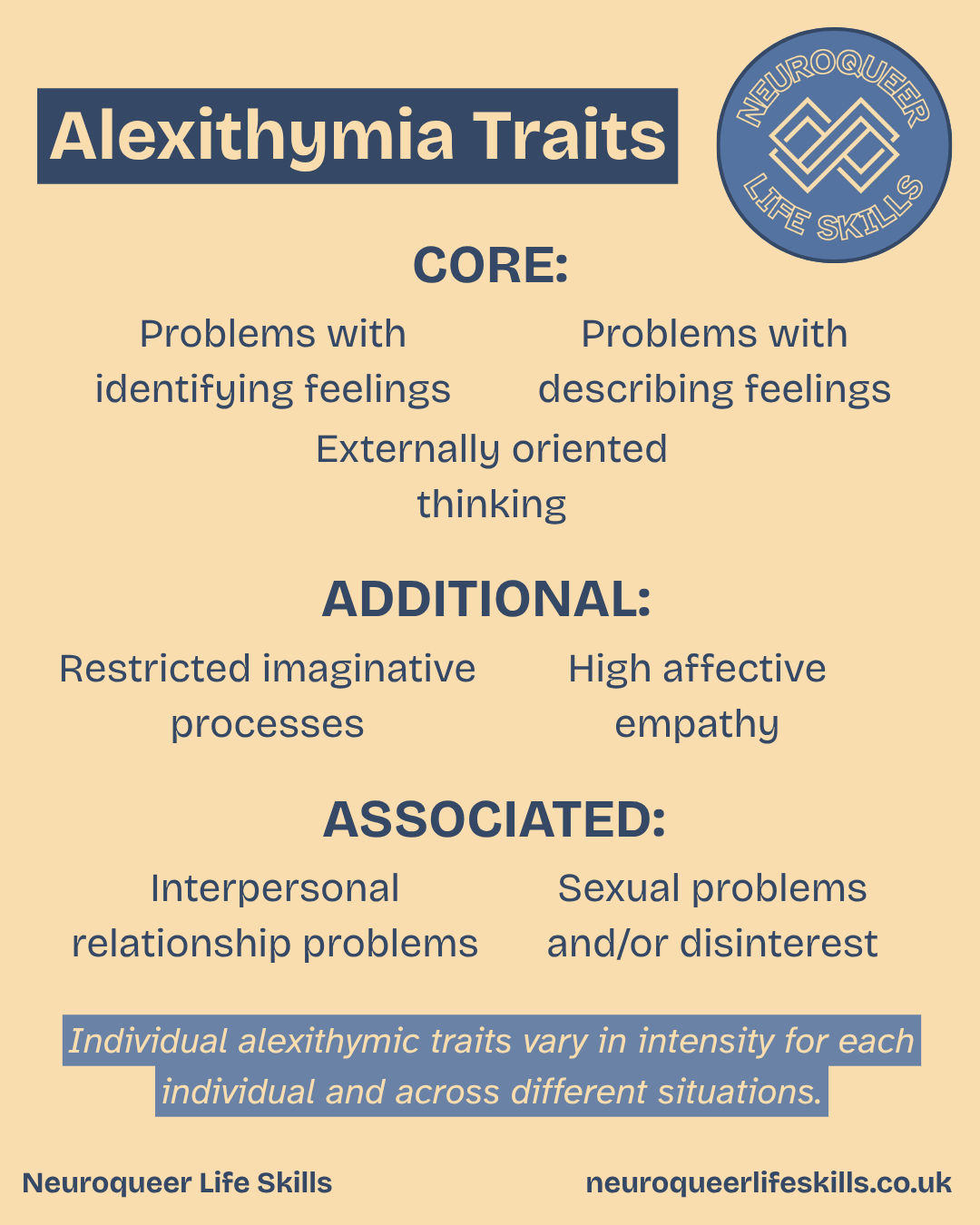
Core Traits:
Problems with identifying feelings might involve struggling to notice and/or interpret the bodily signals that relate to emotions.
Problems with describing feelings could be more internal (eg not knowing what words to use to describe your feelings) or external (struggling to express your feelings to others).
Externally oriented thinking means a persons’ focus is on external events, rather than on their own internal experiences.
Additional Traits:
Some people with alexithymia can have a diminished fantasy life and might daydream less and be less interested in creativity. This is not a ‘core’ feature of alexithymia.
Affective empathy, also called ‘vicarious interpretation of feeling’ refers to when other people’s emotions are strongly mirrored for you internally - for example if someone tells you about a time they felt embarrassed, you might feel embarrassed too.
Associated Traits:
Relationship difficulties aren’t part of the definition of alexithymia, but alexithymia is correlated with reduced cognitive empathy [4], and empathy issues can negatively influence relationships [5], which is why this trait is listed
Sexual problems/disinterest is also not part of the definition of alexithymia, however there are correlations between alexithymia and reduced sexual satisfaction, detachment from sexual partners, sexual shyness and sexual nervousness [6]
Alexithymia is not an inherent part of autism, but many people think it is, either because it is 10x more common in autistic people [7], and/or because many of the stereotypes about autism are actually traits of alexithymia (eg. emotional regulation issues and restricted imagination).
Recent research has discovered that alexithymia is genetically linked to both interoceptive difficulties (difficulties with noticing and interpreting internal body signals) [8 & 9], and sensory sensitivities as a whole [10]. This explains why autistic people can have such hugely different sensory experiences from each other, and why not all autistic people have alexithymia, and may even challenge the idea that sensory sensitivities are a core feature of autism.
We still don’t know why alexithymia is so much more common in autistic people than in the general population, and this is something I think it would be interesting to study. Current theories on the cause of alexithymia include [11]:
Genetics: it’s theorised that because autism and alexithymia so commonly co-occur, and we know that autism is genetic, it must follow that alexithymia is also genetic
Childhood trauma: several studies have shown that adverse childhood experiences and emotional trauma caused by them is associated with higher levels of alexithymia that continue into adulthood
Neurological disorders: Alexithymia can be acquired following brain damage or other neurological disorders such as Parkinson’s Disease
However, these are all just theories, and we don’t truly know what causes alexithymia.
My Theory
My lived and clinical experience has led me to wonder whether, for the roughly 50% of autistic people who go on to develop alexithymia, the cause could be in our childhood environment. There is a theory that a lack of parental ‘mirroring’ can cause children to struggle to recognise their emotions; when a parent doesn’t notice and validate a young child’s feelings (whether intentionally or through neglect), the child doesn’t learn to integrate and accept their feelings [12]. For many autistic people (but, I suspect, especially for those of us whose autism was not recognised during childhood), our autistic-related distress was not affirmed and validated, but was met with denial and confusion.
“We were told: “there’s nothing to be scared of”.
We were told: “nobody else is upset by that sound”.
We were told: “You’re being too sensitive”.”
Thinking back to my own experiences, I was always rewarded for ignoring my sensory sensitivities, the extreme distress that arose from misunderstandings, and my need for routine, clarity and sameness. I was punished, not only by my parents, but also at school, clubs, in friendships and by society as a whole, when my needs clashed with neurotypical norms. I went from being a toddler who had big, dramatic tantrums, to a child who therapised everyone around me, neglecting my own needs. This was highly rewarded, and I learnt that prioritising everyone else’s needs above my own was the only reliable recipe for (small amounts of) social acceptance.
As life became more complex, stressful and overwhelming, I became more and more distanced from my bodily signals. School taught it: if I ignored the loud noises, bright lights, busy corridors, scratchy uniform, smelly cafeteria, toileting/hunger/thirst/pain signals and complex and confusing social rules, I could get through the day without anyone else noticing how much it cost me. Nobody taught me that ignoring my needs would have serious long-term effects on my physical and mental health; on the contrary, I was rewarded with every teenagers’ dream: Not Sticking Out.
I didn’t know why I was so exhausted, anxious and depressed all the time; I thought that everyone else was finding things just as difficult as I was, only that they were coping better. My home environment wasn’t a happy or calm space, and the adults in my life also struggled with day-to-day life. When I asked, I was explicitly told that life is hard and that everyone struggles. That I needed to be less sensitive. So I tried.
The more I learned to neglect and ignore my interoceptive signals, the harder it became to understand and communicate my emotions. By adulthood, life had become a confusing amalgamation of discomfort, fear and anxiety that all blended together, and through it all was a deep vein of self-hatred which told me every bad feeling was my fault. There was never room for trying to identify what the feeling was, or what had caused it.
Nothing I did to suppress and ignore my instincts made life any easier for me. Instead, all the negative feelings turned inwards, until my mental health was, to use a technical term, in the toilet. I spent most of my adult life trying to learn how to free myself from the grip of self-hatred, trying many different therapies and medications. But nothing worked until I realised I was autistic and started to unpick the ways that autistiphobia had decimated my self-esteem.
In my clinical work, I have seen many patients who, like me, functioned with a level of self-hatred which is hard to explain to a neurotypical person. How can anyone imagine how it feels to have been told your entire life that everything you feel is wrong? When I read accounts of extreme childhood emotional abuse, I feel a strange affinity: their experiences aren’t the same as mine, but I do understand what it is like to have aspects of yourself that you can’t change be attacked from all angles.
Children undergoing abuse don’t have the power to reject their abusers. As mammals, we are highly dependent on our caregivers for many years after birth, which means that, when we are abused as children, blaming our caregivers for the abuse is not an option, psychologically speaking. Instead, we find somewhere else to put the blame; usually reflecting it back on ourselves. We develop narratives such as “if I were a better child, my parent wouldn’t have…”. This allows us to continue to go to that parent for care, which is the only option at the time [13].
As an undiscovered autistic child, where do we put the blame for the societal-level neglect and emotional abuse we experience? We don’t have the awareness of structural issues, the criticisms of neurotypical-centred society, that we develop as adults. We (mostly) can’t opt-out of going to school, or family events, or clubs. In a childhood like mine, where the term ‘reasonable adjustment’ was non-existent and ‘special needs’ meant learning disability, there was no escape. Many generations of undiscovered autistic children grew up like me; functional enough to continue to go to school but internally tortured by the demands of the predominant neurotype. The blame for all of this is firmly placed back on ourselves.
The end result, similar to people who experienced more recognised types of child abuse, is an adult who does not trust their instincts, who has reduced connection to their bodily signals, and who doesn’t know how to name, accept or regulate their emotions [14]. Typical mental health treatments can’t begin to reach the complexity of the trauma we carry, or the depth of self-hatred that arises from such widespread and constant rejection. People bounce around different services, receiving treatments that either don’t help them, or make things worse, picking up more and more inaccurate diagnostic labels, all because clinicians don’t understand how mental health presents in autistic people, or the societal trauma that often causes it [15].
Treating Alexithymia
Some people think that autism with co-occurring alexithymia and/or sensory processing difficulties should be treated as an autistic ‘subtype’, with people being offered support to improve their emotional and/or interoceptive awareness. Unlike popular ‘treatments for autism’ (eg. ABA/PBS); which largely aim to eradicate core autistic traits and have been shown to cause mental and physical harm [16-19], treatments for alexithymia do not seek to change a person’s autistic traits, but instead teach them to attend to and understand their bodily signals and, later, to identify different emotional states. This, paired with learning about emotional regulation, can restore to an alexithymic adult the skills that they should have learnt as a child; skills that their caregivers, schools and society as a whole neglected to teach them.
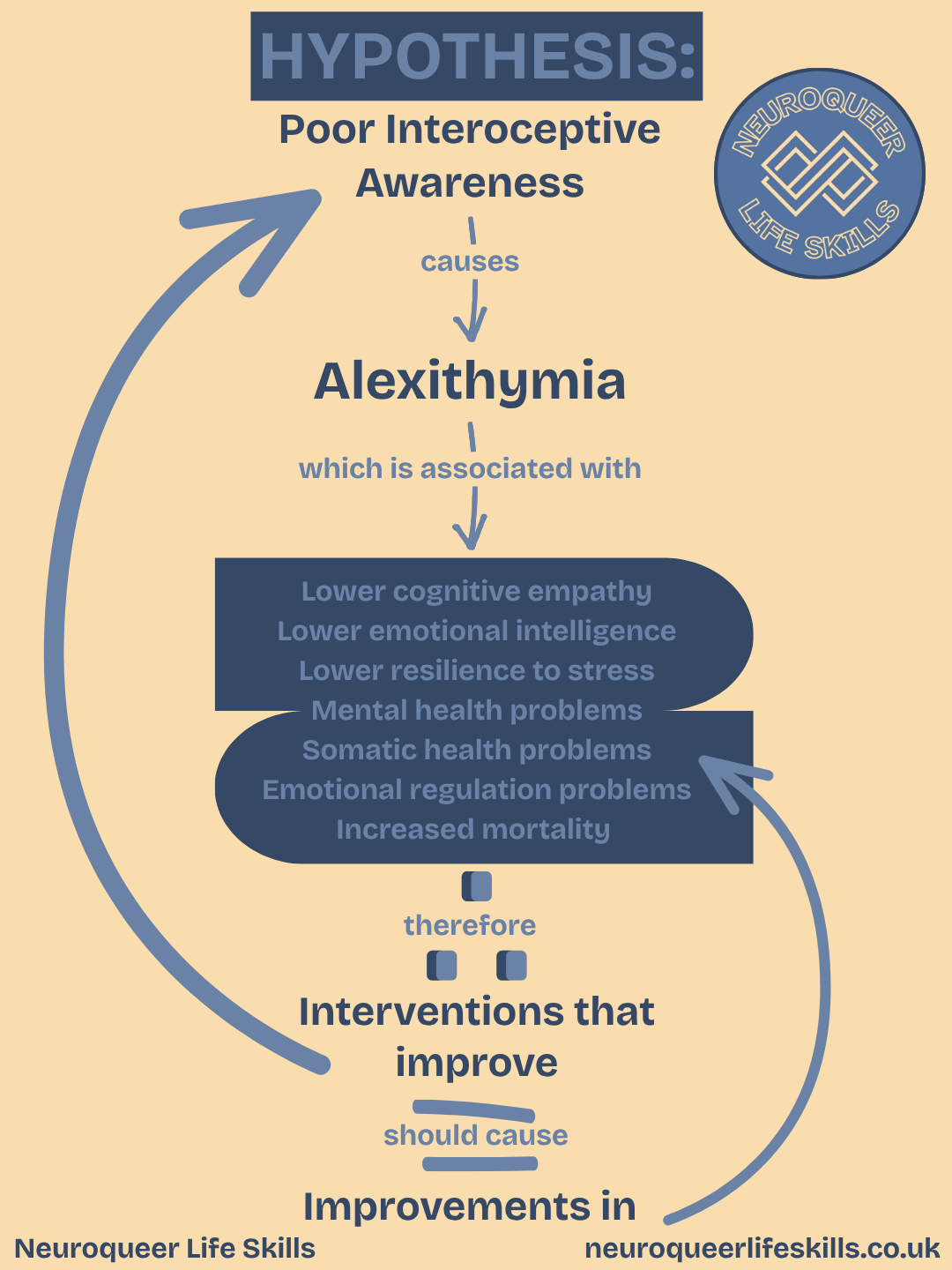
The hypothesis is that because alexithymia is a result of poor awareness of internal bodily signals (both those related to emotion, or ‘affect’, and those that aren’t), improving our awareness of our bodily signals will lessen the experiences that are caused by alexithymia.
Some of these experiences, such as empathy differences, might not feel like problems to be fixed. However, there is evidence linking the more ‘neutral’ of these experiences to effects that are more concretely negative, such as mental and somatic health problems, issues dealing with stress and even increased mortality [20 & 21].
In my last NHS role, I was responsible for designing a new intervention to help neurodivergent patients within a community mental health service. Through lots of trial and error, and following the instincts I was learning to listen to for the first time, I developed a new intervention; a mixture of psychoeducation about neurodivergence and what I coined “neuroaffirmative life skills”. The intervention stole from pretty much everywhere, a collage of different resources, information and exercises, bound together by my instincts, which can be summed up roughly as:
Understanding yourself and your neurotype better is good for your mental health
Detaching yourself from neurotypical expectations and limitations is good for your mental health
It was only a year or more into that job that I realised how big a role alexithymia had in what was contributing to my patients’ mental health problems, and later still when I realised that improving interoceptive and emotional awareness reduced alexithymia, and hugely increased mental resilience and emotional stability. I think the work I was doing was groundbreaking. At the time, I was disenchanted by how few of my patients reported a higher Quality of Life outcome measure after working with me, however, looking back (and at relevant research) I know that when people unmask they often do find their autistic traits increase and day-to-day life gets harder initially.
Developing an intervention within a busy, patient-facing NHS service is chaotic, to say the least. Research-minded principles of treatment development are largely inaccessible, as managers prioritise how many patients you’re seeing, and how quickly they move through the service, not careful, participation-led intervention and theory development. This resulted in my intervention being very much developed ‘as I went’; without time for meaningful quality improvement or data gathering. I’m hopeful that, with the right funding, I could go back to the chaotic, but I think, efficacious, intervention that I threw together and turn it into an evidence-based, repeatable treatment that could be rolled out on a wider basis.
Either way, I’m glad for my journey into alexithymia and what it’s taught me, and I truly hope I can develop it further, and maybe continue to help others.
For support with alexithymia, processing an autism diagnosis or anything else, contact me.
References:
Neff, M. (2024). What is Alexithymia? Alexithymia Defined and Explained. Neurodivergent Insights.Available at: https://neurodivergentinsights.squarespace.com/blog/what-is-alexithymia-alexithymia-defined-and-explained.
López-Muñoz, F., & Pérez-Fernández, F. (2020). A History of the Alexithymia Concept and Its Explanatory Models: An Epistemological Perspective. Frontiers in psychiatry, 10, 1026. https://doi.org/10.3389/fpsyt.2019.01026.
Josyfon, E. et al. (2023). Alexithymia in Adult Autism Clinic Service-Users: Relationships with Sensory Processing Differences and Mental Health. Healthcare, 11(24), 3114. https://doi.org/10.3390/healthcare11243114.
Chakraborty, N., Mehmet, H., & Brugha, T. (2021). Alexithymia and Empathy in a Non-Clinical Population: How do they Correlate?. The Physician, 7(2), 1-8. DOI: 10.38192/1.7.2.1.
Davis, M. H. (2017). Empathy, compassion, and social relationships. In E. M. Seppälä, E. Simon-Thomas, S. L. Brown, M. C. Worline, C. D. Cameron, & J. R. Doty (Eds.), The Oxford handbook of compassion science (pp. 299-315). Oxford University Press. https://doi.org/10.1093/oxfordhb/9780190464684.013.23.
Scimeca, G. et al. (2013). Alexithymia, negative emotions, and sexual behavior in heterosexual university students from Italy. Archives of sexual behavior, 42(1), 117–127. https://doi.org/10.1007/s10508-012-0006-8.
Kinnaird, E., Stewart, C., & Tchanturia, K. (2019). Investigating alexithymia in autism: A systematic review and meta-analysis. European Psychiatry, 55, 80–89. https://pubmed.ncbi.nlm.nih.gov/30399531.
Mul, Cl. et al. The Feeling of Me Feeling for You: Interoception, Alexithymia and Empathy in Autism. J Autism Dev Disord, 48, 2953–2967 (2018). https://doi.org/10.1007/s10803-018-3564-3.
Clemente, R., Murphy, A., & Murphy, J. (2024). The relationship between self-reported interoception and anxiety: A systematic review and meta-analysis. Neuroscience & Biobehavioral Reviews, 167, 105923. DOI: 10.1016/j.neubiorev.2024.105923.
Yorke, I., Murphy, J., Rijsdijk, F. et al. Alexithymia may explain the genetic relationship between autism and sensory sensitivity. Transl Psychiatry15, 75 (2025). https://doi.org/10.1038/s41398-025-03254-1.
Hogeveen, J., & Grafman, J. (2021). Alexithymia. Handbook of clinical neurology, 183, 47–62. https://doi.org/10.1016/B978-0-12-822290-4.00004-9
Braman, L. (2025). Alexithymia Illustrated: 4 Comics about Alexithymia Origins and Treatment. Lindsaybraman.com, Available at: https://lindsaybraman.com/alexithymia-origins-and-treatment/
Zhang, H. et al. (2025). The association between child maltreatment and shame: A meta-analysis. Child Abuse & Neglect, 167, 107557. Available at: https://doi.org/10.1016/j.chiabu.2025.107557
Stagg, S. D., & Belcher, H. (2019). Living with autism without knowing: receiving a diagnosis in later life. Health psychology and behavioral medicine, 7(1), 348–361. https://doi.org/10.1080/21642850.2019.1684920
Brede, J. et al. (2021). “We Have to Try to Find a Way, a Clinical Bridge” - autistic adults' experience of accessing and receiving support for mental health difficulties: A systematic review and thematic meta-synthesis. Clinical Psychology Review, 93, 102131. Available at: 10.1016/j.cpr.2022.102131
Marshall, S.N. et al. (2025). Autistic Experiences of Applied Behavior Analysis (ABA): Toward Improved Autistic-Centered Supports. Journal of Social Issues, 81(4), p. e70037. Available at:https://doi.org/10.1111/josi.70037.
Neurodiverse Connection. (2025). Against PBS & ABA. Neurodiverse Connection, Available at: https://ndconnection.co.uk/against-pbs-aba.
Dawson, M. (2004). The Misbehaviour of Behaviourists. Sentex.ca. Available at:https://www.sentex.ca/~nexus23/naa_aba.html.
Dawson, M. and Fletcher-Watson, S. (2022). When autism researchers disregard harms: A commentary, Autism, 26(2), pp. 564–566. Available at:https://doi.org/10.1177/13623613211031403.
Parker, J.D.A., Taylor, G.J., & Bagby, R.M. (2001). The relationship between emotional intelligence and alexithymia, Personality and Individual Differences, 30(1), pp. 107-115. Available at: https://doi-org/10.1016/S0191-8869(00)00014-3
Brewer, R., Cook, R., & Bird, G. (2016). Alexithymia: a general deficit of interoception. Royal Society open science, 3(10), 150664. https://doi.org/10.1098/rsos.150664
